The Family Behind the Names
When Karl Fast published Gebt der Wahrheit die Ehre! in 1950, the war was five years past and his mother and brothers were still inside the Soviet Union — where a name in a Canadian book could cost its bearer dearly. He wrote as “Abram Siebert” — keeping his own birth name inside the alias — and gave his family protective surnames; in the story, as in life, the war makes him take a new first name, and the second book knows him as “Heinz Siebert” throughout. This page sets the record beside the story, with the family's own words about the people they loved.
The Names
Who is who, across both books.
| In the books | In life |
|---|---|
| Abram Siebert, later “Heinz” | Karl Fast (born Abram Fast), 1921–2005 — the author. In Gebt der Wahrheit die Ehre! he is Abram, who adopts the cover name Heinz during the war; in Laß dir an meiner Gnade genügen he is Heinz throughout. |
| Ella, later Grete | Margaret (Greta) Fast, née Penner, 1924–2022 — his wife |
| Lilli / Hilde | Hilde, born in Osmolin, October 1944 — their first daughter |
| Mutter Siebert | Katharina Fast — Karl's mother, who never left the Soviet Union |
| Gerhard · Hans · Peter | Karl's brothers — the books kept their real given names |
The quietest revelation is the author's own name: he was born Abram Fast, and took the name Karl during the war years — and the first book narrates that very change under its aliases. Its hero is Abram Siebert, until the day he must invent a cover identity: “Siebert chose the Germanic name Heinz… Abram Siebert existed no more.” The Soviet verdict in Part Three still reads “Abram (alias Heinz) Siebert.” In Margaret's Lebenslauf he is both men at once — “Abram, or Karl as he was now called.” His father, too, was named Abram.
Karl Fast · August 26, 1921 – April 1, 2005
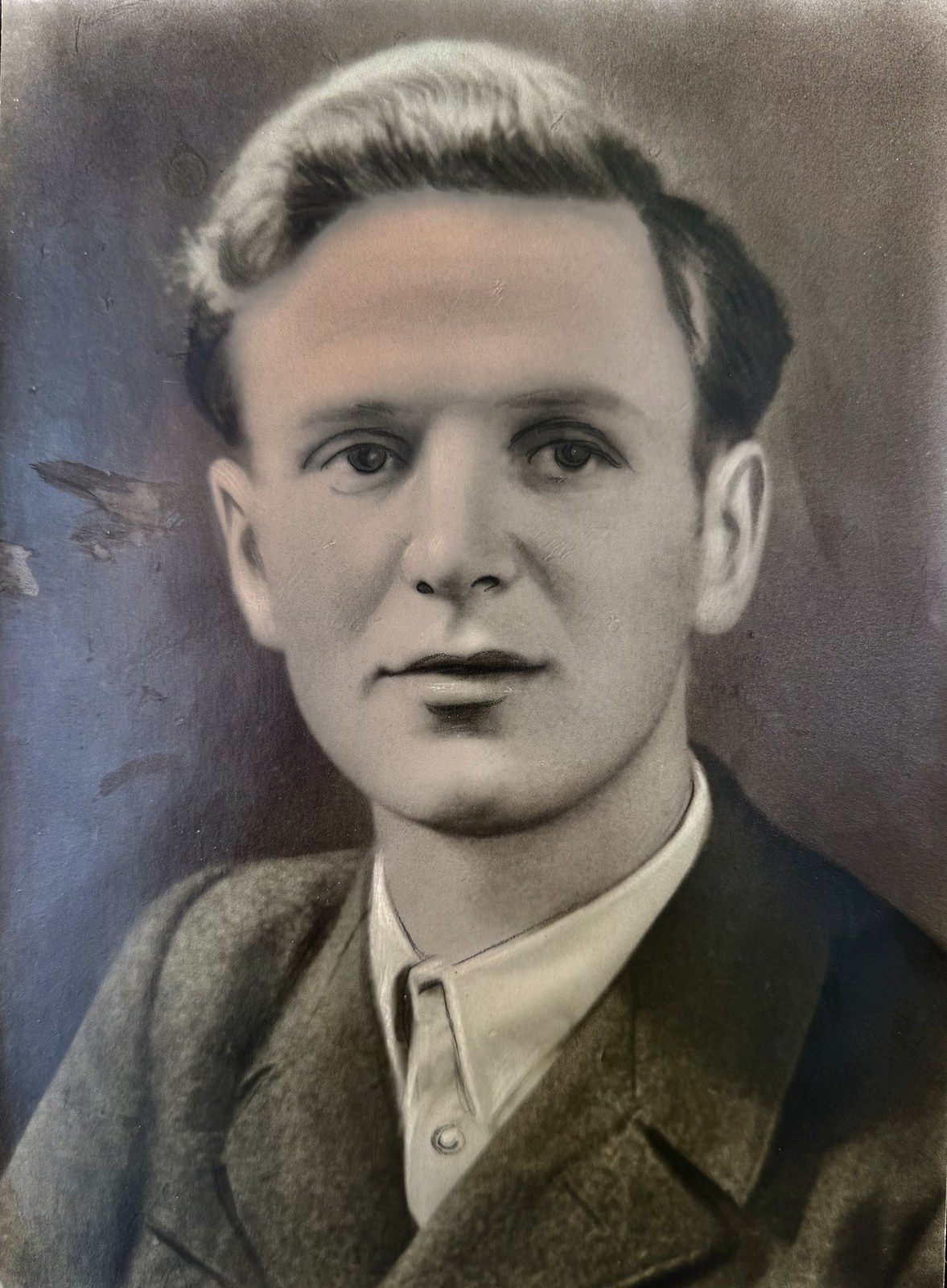
From his family's farewell — Winnipeg Free Press, April 4, 2005.
Karl was born in the Orenburg Mennonite settlement in Russia on August 26, 1921. After the war in Europe — and five years as a prisoner of war in Russia — he was reunited with his wife and daughter in Germany and settled in Winnipeg in 1949, where, his family wrote, he grabbed hold of every opportunity the country offered. He worked physically for his first years, holding on to the dream of returning to his interrupted education; while working as a printer's helper at City Press, he wrote the first book — the account his children said gave them an insight into who he was, and “purged and clarified him in writing.”
He studied nights and summers at the University of Manitoba, earned his Bachelor of Arts, and began teaching in 1958 at Westgate Mennonite Collegiate, later in Lowe Farm and at Steinbach Regional Secondary School. From January 1972 until his retirement in 1986 he served as a language consultant in Manitoba's Department of Education, counting among his greatest legacies the development of second-language teaching in the province — training teachers and introducing curriculum for the Ukrainian, Hebrew, and German bilingual programs, and working with teachers on Hutterite colonies across Manitoba.
Through all of it he gave his energy to his churches, North Kildonan Mennonite and Springfield Heights Mennonite — Sunday school, German school, ordination as a lay minister in 1972. His family wrote that he honoured his commitment to God for his deliverance from the terrors of war and imprisonment, and did so with grace and joy. He died peacefully at the Bethania Personal Care Home after a long struggle with Parkinson's disease, his wife Margaret at his side.
Margaret Fast · August 24, 1924 – November 1, 2022
At her funeral, six of her grandchildren rose in turn to read her Lebenslauf — the account of her life she left in her own words, continued by her children. It is given here as it was read.
I, Margaret Fast, was born on August 24, 1924, in Alexandrovka (Neuland), Ukraine. My parents were Johann and Maria Penner. They had eight children, seven of whom survived to adulthood: Maria, Johann, Peter (Isaak), Jakob, twins Anna and myself, and Heinrich and Tina. Tina died young.
My childhood years were happy, despite the poverty and political unrest that defined the time. I attended school to grade seven, after which Ukraine became increasingly unstable, and schools were closed. We were forced into a world of work and increasing unrest.
War brought many changes to our village, some welcome, some not. One of the positive consequences of the German occupation was the resumption of school. The other was the arrival in 1942 of Abram Fast in our village. He had escaped the Russian military and found his way to Ukraine, walking along rail lines for three months. He had been told he had relatives in Ukraine in a Mennonite village. Since he had grown up in Eastern Russia, he now encountered Mennonites in Ukraine for the first time. He was assigned as a teacher in the village, and he and I fell in love. On Pentecost 1942 we were both baptised, together with 75 other young people. After many years of church being banned, it was great to gather as a large community and a large choir!
By October 1943, we were married amidst growing fears of the coming conflict and possible evacuations. Ten days after our wedding, we were forced to flee with the retreating German army. This flight included all our family and fellow villagers. We got to the German-occupied territory of Western Poland, known as the Warthegau. Here we were assigned living quarters. Because my husband was a teacher, we were housed in the schoolhouse in Osmolin. My parents were in Schadeck, about 15 kilometres away.
In June 1944, all the men were drafted into the German army, including all my brothers, my brother-in-law Gerhard Neufeld who had married my sister Maria, and my young husband. I was now alone in an empty schoolhouse in the middle of nowhere it seemed. Thankfully my brother Jakob was stationed in Freihaus, not too far from me. I was expecting our first child by now and knew I would need help at some point. Jakob checked up on me regularly, for which I am grateful to this day. One day I found myself staring out of a second-storey window of the schoolhouse and observed an oncoming army of Cossacks. They had allied with the Germans, and I did not fear them as enemies, but I was all alone, female, pregnant, and totally defenceless. For some reason, I stayed calm in the certain knowledge that Jakob would arrive in time. And so it was. He must have learned of the Cossacks' arrival and headed to see me. I saw him speaking to the leaders, and although some of the soldiers were already on the main floor, they were all persuaded to leave. I had stayed quietly upstairs and waited for Jakob. When he came to me, his first question was, “Weren't you scared?” I remember saying something like, “No, I knew you would come.”
When it was time for Hilde to be born, Jakob brought the midwife. It was a challenging experience, but I now had a child to remember Abram by. Abram, or Karl as he was now called, received a telegram of my news and came to see us for a week or so. This brief reunion was followed by orders to return to his company, and shortly after he was sent to the front.
In January 1945, three months after the birth of my baby, we fled again, on wagons and on foot, to Hannover, in West Germany. With the assistance of Mennonite Central Committee, we were sent to Gronau in Westphalia. As refugees, we were placed with a family named Hubbeling. They had a large farm, and this is where Hilde and I spent many happy years waiting to hear from Karl, our husband, and father. This family remained in contact with us long after we left for Canada. They visited us in Winnipeg years later and I remember so well the reception they gave us when Karl and I came to Germany in 1986. The whole extended Hubbeling clan, with the exception of the parents who had taken us in so long ago, was at the airport to greet us. They had reserved a restaurant and treated us as dear friends. It is one of the memories I cherish, mainly because it was a direct result of my own relationships and experiences, independently fostered at that difficult time in my life.
In September 1949, we were reunited as a family when Karl was finally released from the Russian prisoner-of-war camp. My parents and sister Anna and my brother Jakob and family had left for Canada the previous year, my brothers Johann and Peter had fallen as victims of the war, and Heinrich was missing in action, and so our little family made plans to join my parents and siblings in Winnipeg. We arrived in Winnipeg on December 3, 1949.
In Canada four more children were born — Lorie in 1951, Marlies in 1953, and Karl and Agnes in 1956. Our mother was a woman of her time: a tireless supporter of her husband, which allowed him to work, study, write, and fill his days and evenings with the work he felt called to do. She never worked outside the home, but she certainly worked hard in it — a seamstress for her girls, an excellent cook and baker, and a hostess whose house was filled with guests most weekends, open to friends, to overnight visitors from across Canada, and later to long-lost family from Russia and Germany.
She served her churches — North Kildonan Mennonite and later Springfield Heights Mennonite — on committees and at the Westgate Thrift Store, where she made many friends. She and Karl travelled once they could: Europe, Eastern Canada, Hawaii, Mexico — and after his retirement, a year working with Umsiedler, Russian-German immigrants, in Unna-Massen, Germany, where she was critical to his work. From the early 1990s, when Karl was diagnosed with Parkinson's disease, until his death in 2005, she was at his side continually — nearly four years at Bethania, visiting every day.
She cared for each grandchild, great-grandchild and great-great-grandchild. She remembered each birthday, made chicken soup for each birth, and would bake her famous Fleischperischke endlessly if anyone even hinted at wanting some. She died peacefully on November 1, 2022, at 11:45 pm, surrounded by her children — a strong, loving woman to the end, clear and bright almost to the last.
Sixteen grandchildren, forty-three great-grandchildren, and two great-great-grandchildren survive her. She was laid to rest at Sage Creek Cemetery, Winnipeg, following the funeral at Douglas Mennonite Church on November 7, 2022.
Marlies Klassen · December 27, 1953 – March 31, 2014
Their daughter — born in Winnipeg, the third of the Canadian children.
Maria Luiese (Marlies) Klassen, née Fast, was her father's daughter: her family wrote that her role model was her papa, whose love of life and of God led her to baptism in the spring of 1972 — the same year Karl was ordained. She married Otto Klassen that November at Springfield Heights Mennonite Church and made her life's work her own family: four children; a certificate in Early Childhood Education earned in evening courses; twelve years teaching at the Springfield Heights Mennonite Church German Nursery School — more than three hundred children — and then a daycare of her own. Her grandchildren, her family said, were the music in her life; so was the Faith and Life choir, which carried her across the province and the globe. She died suddenly on March 31, 2014, on the eve of the ninth anniversary of her father's passing.
Sources
This page draws on the family's own records: the Lebenslauf of Margaret Fast, read at her funeral by six of her grandchildren; the obituary of Karl Fast (Winnipeg Free Press, April 4, 2005); the obituary of Margaret Fast (Winnipeg Free Press, November 2022); and the obituary of Marlies Klassen (Winnipeg Free Press, April 4, 2014). Where these records and the books differ in a date or a place, the difference is flagged in the project's research documents and on the map's story panels rather than smoothed over — the site's name is a promise.